Senior full-stack developer · Kreuzlingen, Switzerland
Christof Müller
Angular, TypeScript, Node.js and NestJS, building software since 1995. I take products from architecture to operation and use AI so that checks in code have the final say, not the model.
- Available from December 2026
- German & English
- Building software since 1995

 Insolvenzen
Projects
Five own products and one client project. Each section describes what the software does, what it is built with, and how AI is used and kept under control.
-
Network inventory for Mac, Windows, Linux, iPhone and Android. Finds the devices on the network, identifies them and shows open ports and security findings.
- Go
- Wails
- Flutter
- Playwright
-
Financial planning for customers and advisors, with a calculation engine built from Excel and an AI assistant that never makes up a number.
- Angular
- NestJS
- Keycloak
- AI assistant
-
A device that alerts family when the usual morning activity of someone living alone does not happen. No camera, radar only.
- Raspberry Pi
- NestJS
- Python
- mmWave
-
Encrypted inventory for servers, services, domains and credentials, with SSH scan, terminal, uptime checks and AI help with logs.
- Rust
- Tauri
- Angular
- SQLCipher
-
Finds, controls and schedules Tasmota devices directly on Wi-Fi, with no MQTT broker and no server.
- iOS
- Android
- Tasmota
- Matter
-
Capture and post receipts for Swiss SMEs automatically, with local OCR and account suggestions based on the Swiss SME chart of accounts.
- Angular
- NestJS
- Ollama
- Qdrant

Own product · since 2026
DeviceShelf
DeviceShelf scans the local network, identifies devices and services and monitors them. Scans run locally on your own network. It ships as a desktop app, as mobile apps and as a server edition for always-on use.
What it does
- Device and service discovery via ARP, mDNS, SNMP and port fingerprinting, plus hypervisor inventory (VMware, libvirt).
- Live monitoring, vulnerability matching, bandwidth and a yearly report per network.
- Server edition as a Docker image with a web dashboard; the mobile app pairs with desktop or server.
Technology
Go 1.26 with Wails v2 (desktop and server), vanilla JS with Vite on the front end, Flutter with Riverpod for iOS and Android. Libraries include gopacket, gosnmp, fingerprintx, govmomi, MQTT and the official MCP SDK.
Quality and security
- Tests: 415 Go test files, 114 Dart test files, 91 Playwright specs (front end, server E2E, desktop E2E).
- Accessibility: an automated WCAG 2.1 AA / EN 301 549 gate with axe-core and Playwright across every view, both themes, right-to-left and zoom.
- Release: build, sign, notarise, upload and tag in one script; 136 releases up to v1.9.62.
- Merge gate: a merge to main only succeeds when the acceptance tables pass. Third-party licence notices are enforced at commit time.
AI in the product
Five opt-in AI features that run with your own key (Anthropic, OpenAI-compatible or local via Ollama): chat about your own network, device identification with a suggestion, vulnerability triage, security tips and a network digest. An MCP server for AI assistants is off by default, LAN-only and token-protected.
How the AI is controlled
- Device names, banners and scan data reach the model as untrusted input, never as instructions.
- Whatever the model suggests passes deterministic checks before it is stored. Nothing is applied without the user’s consent.
- The safeguards are recorded per feature in a table: path, barrier, test case, known gap.
- During development, hooks block force-push, hard reset and plaintext secrets. An agent works one issue per worktree and opens a pull request; merging happens after human review.

Client project via Bellini Personal AG · since 2025
WealthWallet
WealthWallet works through pensions, investments, mortgages, buy-or-rent and life events and shows projections. Advisors only see client data after the client grants time-limited access and confirms it with a passkey. I am responsible for product development and delivery.
What it does
- Customers maintain their financial data and try scenarios; advisors work in a separate app with a client list and grants.
- The business team maintains the calculation model in Excel. It is compiled into a formula graph that a dedicated service evaluates; application code never recalculates anything.
- Grants are time-limited, passkey-confirmed and checked on every access. If a service is down, access stays closed.
Technology
Nx monorepo with Angular 22 and NgRx Signals, Capacitor 8 for the mobile apps, NestJS 12 with Postgres, MongoDB and Redis, Keycloak 26 for login and sign-up, Vitest and Playwright for tests, Figma Code Connect for the design system.
Quality and security
- Checks before every push: type check, lint, every number traced to Excel, key discipline, thin components (logic in services), design system without raw colours, every route opened by an E2E test, no import cycles, contrast of the login theme.
- Tests: Vitest per project, Playwright E2E, a coverage floor that can only go up, and acceptance lists for business cases.
- Design fidelity: every component carries its Figma source; fonts and spacing are measured against the Figma frame.
AI in the product
The AI assistant answers questions about your own plan and runs scenarios. The model (local via Ollama or OpenAI, by configuration) picks what may be simulated from a fixed catalogue. Calculation only starts after the user clicks, and nothing is saved.
Try it yourself
If you want to see it for yourself, you can create your own account. A new account only sees what you enter. The personal link in my application also includes a prepared demo login.
How the AI is controlled
- Numbers never travel through the model. Any model sentence containing a digit or a raw Excel key is dropped. Numbers only appear on cards the server builds from engine results.
- The model never picks keys. Language maps to a reviewed catalogue, the catalogue maps deterministically to engine keys.
- No write path. One test checks that there is no route from the model to storage; another replays bypass attempts with a deliberately hostile fake model.
- Switches: the assistant sits behind its own role and a kill switch.

Own product · since 2023
einerda
An mmWave radar sensor detects presence in the room without capturing images. If the expected morning activity is missing, family members get a push notification. I built the hardware setup, device software, cloud and app.
What it does
- A Python sensor service reads the radar; a NestJS service on the Pi evaluates and reports to the cloud.
- Wi-Fi setup over Bluetooth; if internet or cloud are down, the device queues events and delivers them later.
- Updates arrive as signed over-the-air bundles.
Technology
Nx monorepo, NestJS 10 with helmet and rate limits, Python services for sensor and GPIO, a BLE service for setup, MQTT, Postgres, systemd units on the Pi, Capacitor app for iOS and Android.
Quality and security
- Security controls with an ID, code location and manual verification command: fail-closed secrets, default-deny guard on the LAN, RS256 JWTs with revocation, per-device Ed25519 signatures with replay protection, AES-256-GCM at rest, append-only audit log, automatic retention, right to erasure.
- Updates: signature chain with root and intermediate keys, revocation list and kill switch; a new bundle must pass three health checks in a row or the device rolls back, even after a power cut.
- Data protection: impact assessment under Swiss FADP Art. 22 and GDPR Art. 35 with a risk register; CE preparation documented.
AI in the product
There is no AI in the product. Detection uses fixed, traceable rules.
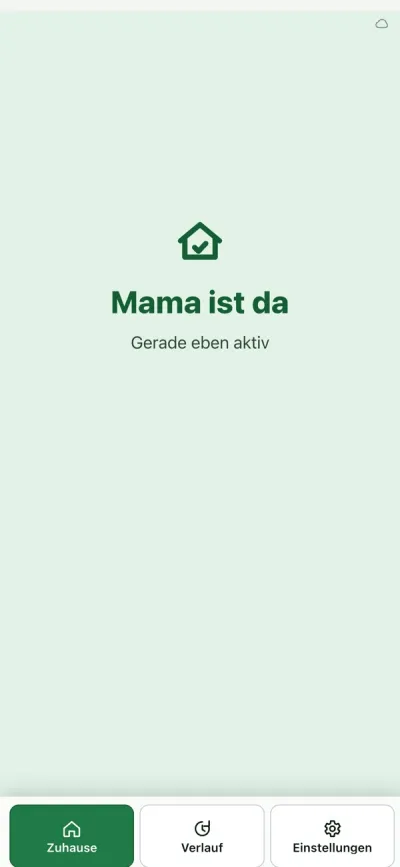
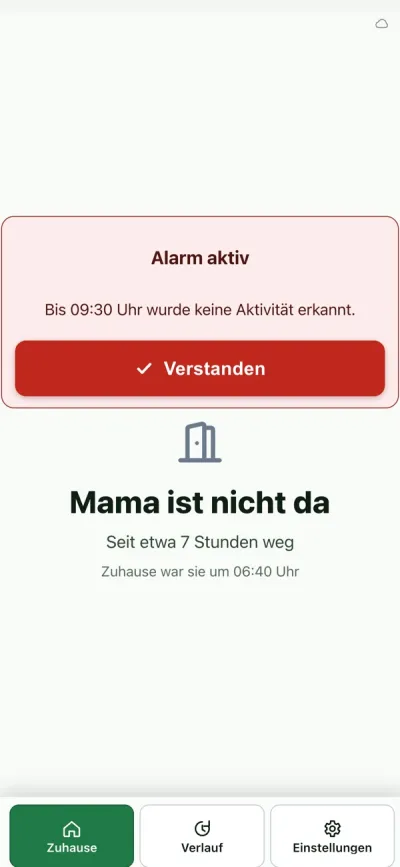
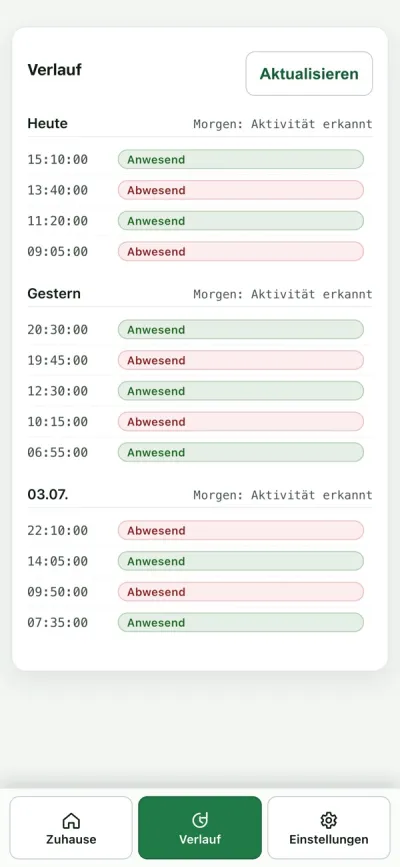
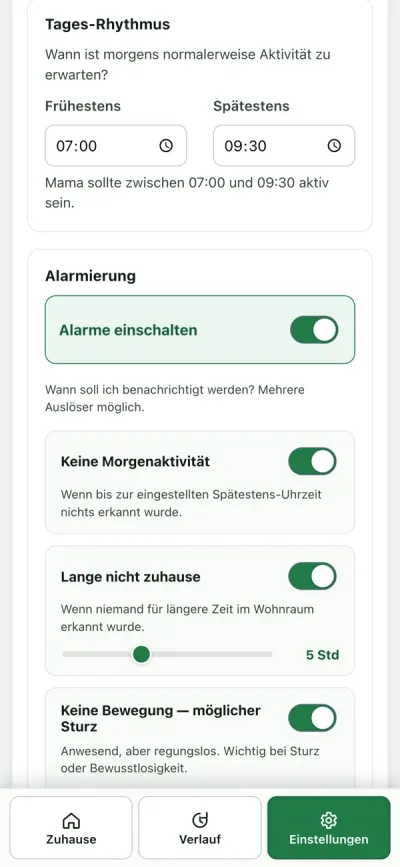
Screenshots of the iPhone app from the App Store (German UI).
How the AI is controlled
- Changes to network, boot or power on a customer device require a built-in way back (a watchdog restores the old configuration if the device does not check in), go to the test device first and reach the customer only after hours of observation.
- AI agents co-wrote code and tests; every security control in the document lists the command it was verified with by hand.

Own product · 2026
ServerShelf
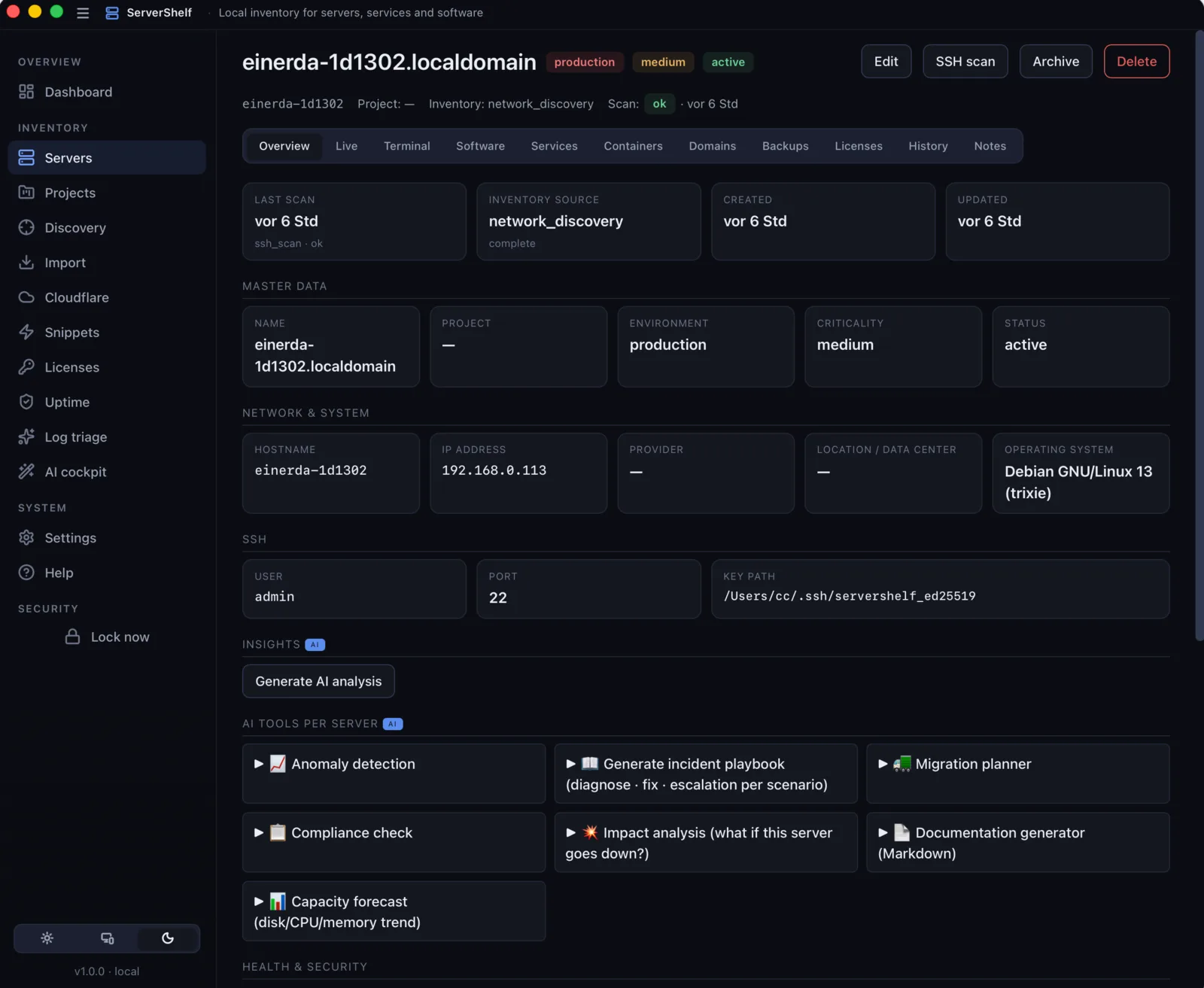
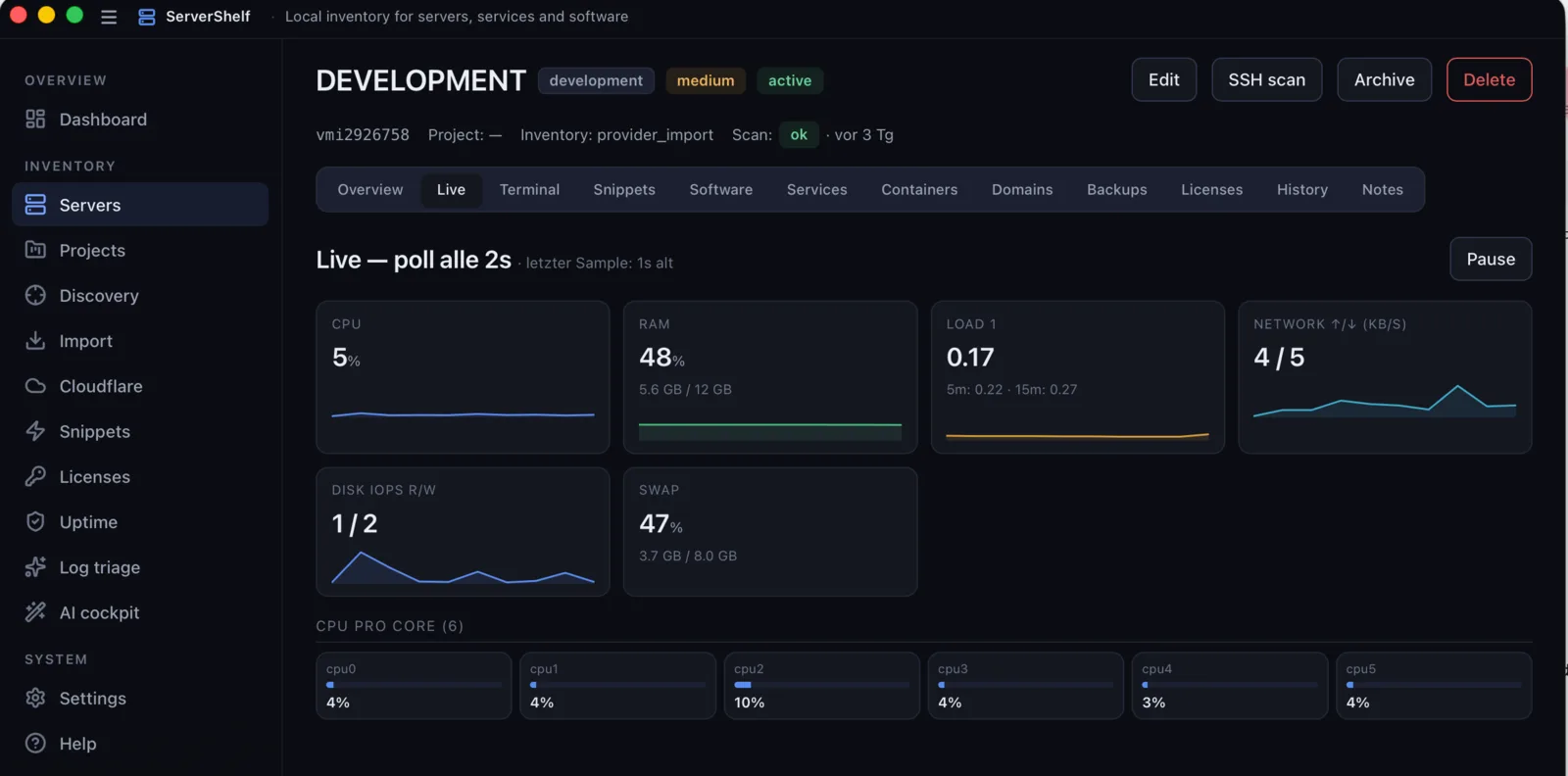
ServerShelf records which service runs on which server, where each domain points and where the credentials are. The data stays encrypted on your own machine.
What it does
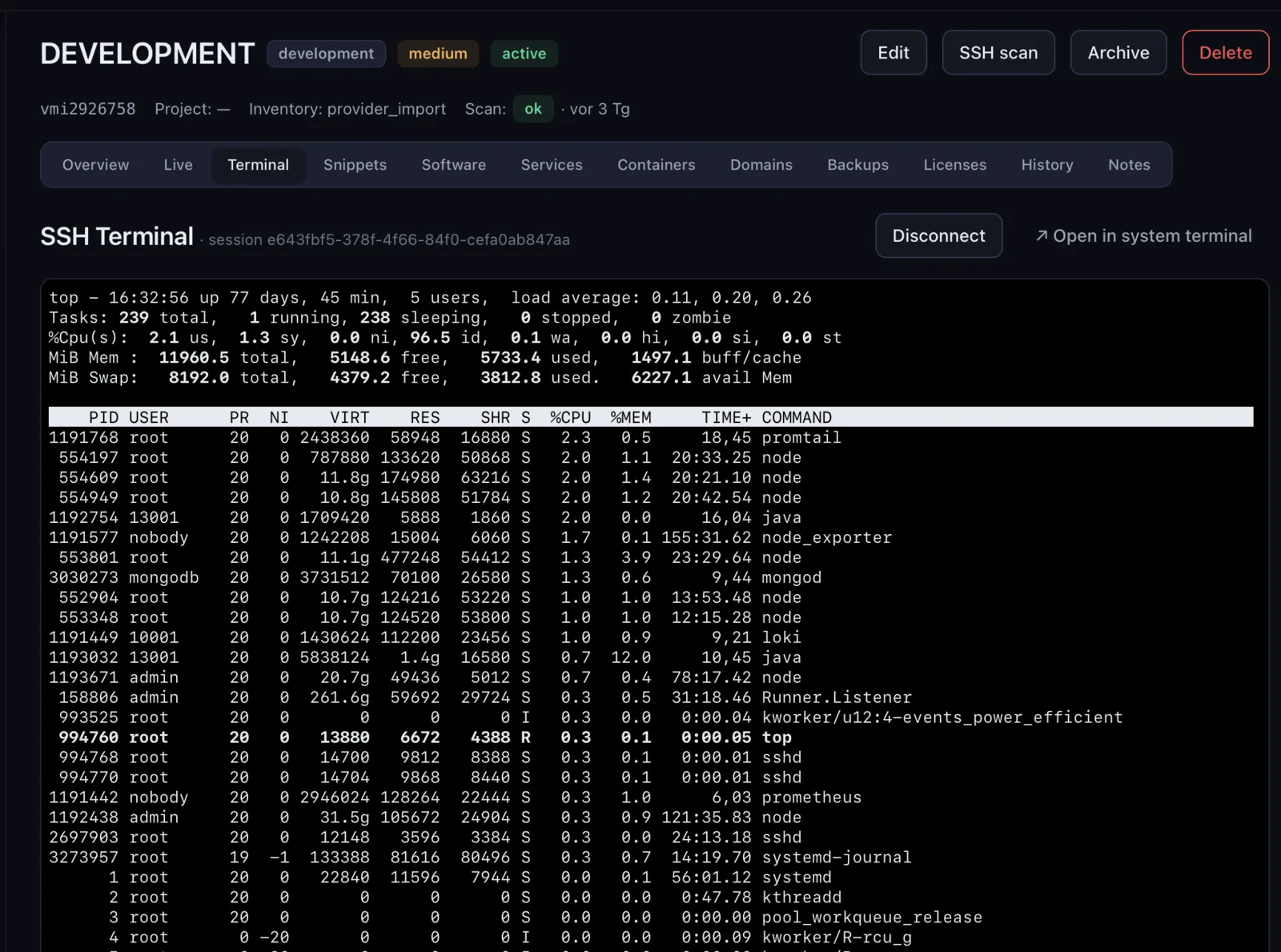
- Read-only SSH scan, a built-in terminal, uptime and certificate checks, import from hosting providers.
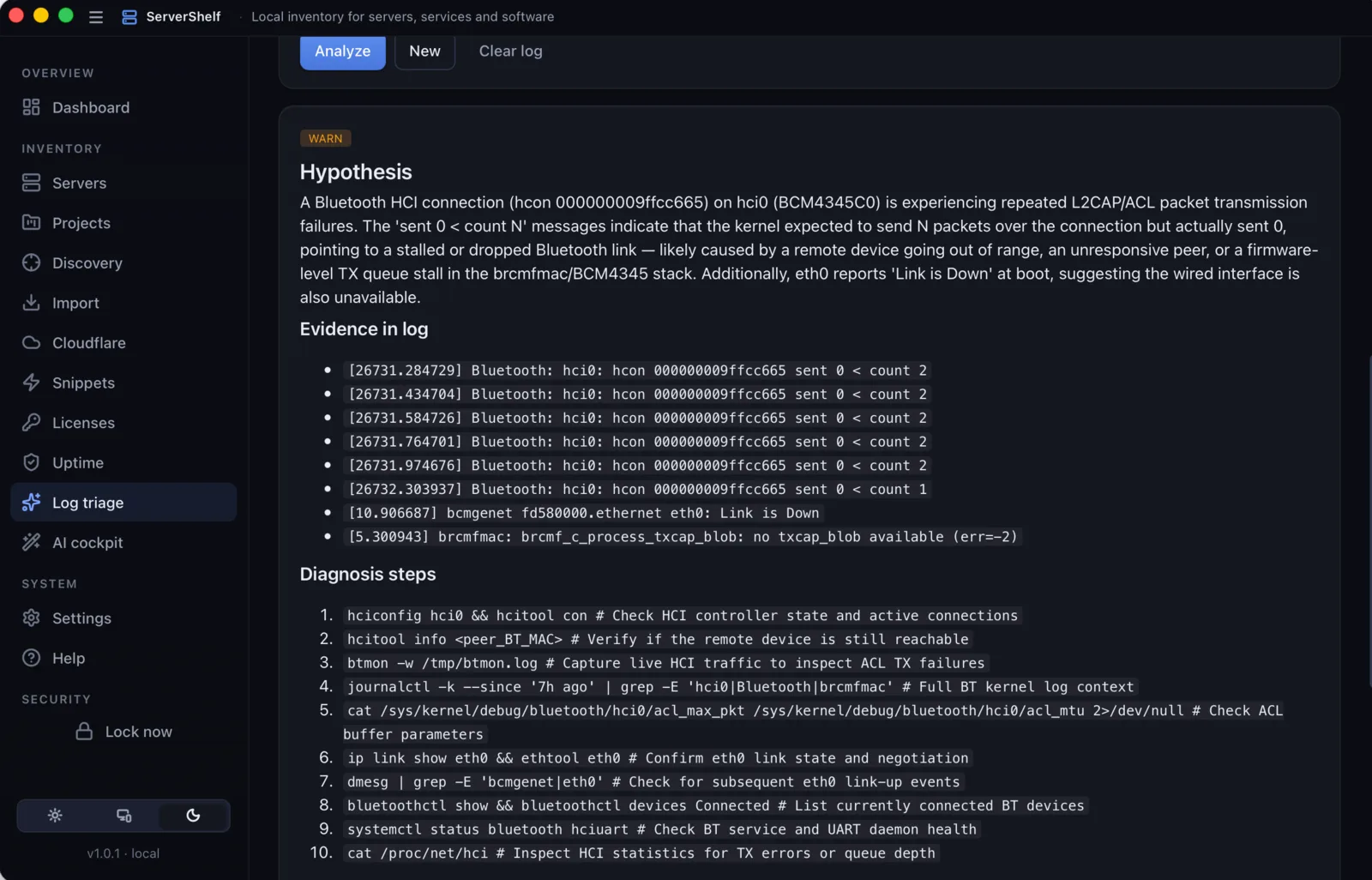
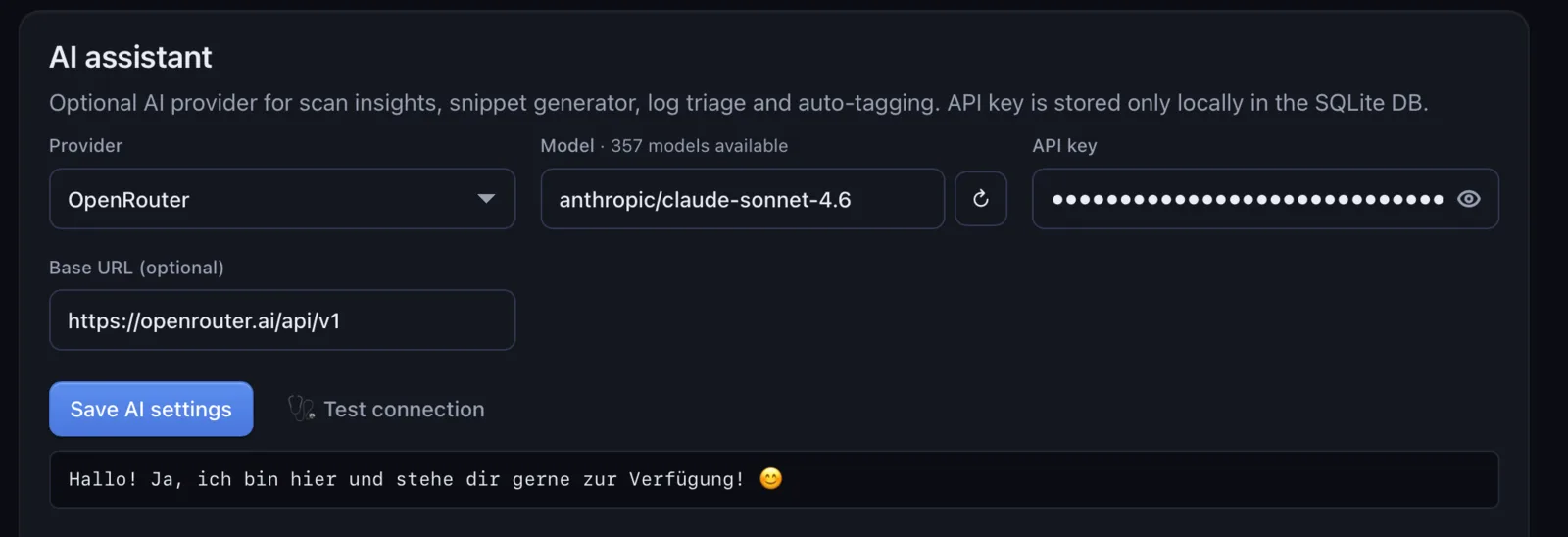
- AI cockpit and log triage with a provider of your choice (Anthropic, OpenAI, Mistral, Gemini, OpenRouter and more).
Technology
Tauri 2 with a Rust back end and Angular 21 on the front end, rusqlite with SQLCipher, russh, axum, rustls, aes-gcm, argon2, ed25519-dalek, xterm.js and Transloco; companion app in Flutter.
Quality and security
- Vault: the database is encrypted with SQLCipher; the key is sealed twice via Argon2id from a passphrase or a recovery code. Touch ID guards access, secrets are wiped from memory after use.
- Offline licence with an Ed25519 signature, no server needed.
- Releases signed and notarised.
AI in the product
The AI cockpit and log triage use the provider and API key the user enters. Results are stored separately from the inventory data.

Own product · 2026
TasmoShelf
TasmoShelf finds Tasmota plugs and switches on the home network, including ones in Wi-Fi power-save mode, and controls them directly. Timers run on the device itself; backups and an energy view are built in.
What it does
- Two-pass discovery so sleeping devices are not missed.
- Rooms and groups, on-device timers, console, backups and a Wi-Fi settings comparison.
- Built-in product catalogue, offline licence check on the device.
Own product · since 2023
Receipt recognition
Receipts arrive by upload or through a watched folder. The app reads the text, suggests an account and lets you approve receipts in batches. The end result is the annual statement as PDF or Excel.
What it does
- OCR first runs locally with a vision model via Ollama, falling back to Taggun or AWS Textract.
- Three-step account suggestion: fixed rules per vendor, a search for similar past receipts via embeddings in Qdrant, and only then a language model.
Technology
Angular 17 with NgRx, Angular Material, PrimeNG and ag-Grid; NestJS 10 with TypeORM and MySQL; Qdrant, n8n, pdfkit and exceljs; tests with Jest and Cypress.
AI in the product
The language model only comes in when rules and similar receipts give no suggestion, and it only suggests. Posting happens after a human approves.
Older apps
iPhone app for searching the official German insolvency portal, in the App Store since 2015, now on Angular 20, Ionic 8 and Capacitor 8. Data stays on the device.
Mac utility for login items, storage and processes, with AI explanations using your own key. In preparation.

Approach
How I work with AI
AI agents write a large share of my code. To keep the result reliable, a fixed order applies: what only lives in a prompt is a request. What lives as a check in code is enforced.
The barrier sits outside the model
A prompt asks and a model may refuse, but only code outside the model can guarantee anything. Every “never” rule is built so that there is no executable path from model output to the protected asset, and it is proven by a test against a deliberately hostile fake model.
Numbers and facts come from the source
Calculated values come from the business team’s Excel model, field bindings from the Figma annotation. If a value is missing, the UI shows a visible error instead of a plausible guess.
Checks in the repo, not good intentions
Every rule exists as a script that runs before the push: types, lint, design system, thin components, provenance of numbers, E2E for every route, accessibility. Green means the hook script ran, not “I checked the important ones”.
A second model reviews, I reproduce
Reviews run on different models (Codex, Kimi) from the one that wrote the code. I reproduce every finding before accepting it. A good share of outside findings does not survive that check.
Every bug becomes a test case
A growing regression list runs in full after every change. Every new test is seen failing once against the unfixed code; a test that does not fail there is decoration.
Agents with guardrails
Hooks block force-push, hard reset and plaintext secrets. Agents work in their own worktrees, nothing goes out without approval, and merging waits for my own test.
Career
More than thirty years of software development, the last ten mostly Angular and TypeScript.
- since 2025
AI-assisted full-stack development
Bellini Personal AG, Zurich · client project WealthWallet
Product development and delivery of a financial planning app: Angular, NestJS, Capacitor, Keycloak, an AI assistant with guardrails.
- since 2023
Own software products
IT Services Müller, Kreuzlingen
einerda, receipt recognition, DeviceShelf, ServerShelf, TasmoShelf: from idea to store release.
- 2021 – 2023
Front-end development
Helsana Versicherungen AG
Insurance portal with Angular and NgRx in a DevOps Scrum team, Angular migrations 11 to 14, build and deployment pipeline.
- 2020
Front-end development
AXA Versicherungen AG
Migrated an AngularJS Electron app to an Angular PWA, introduced Cypress into the build pipeline.
- 2018 – 2019
Senior Angular developer
Allianz Suisse
New broker and customer portals as reactive single-page apps.
- 2013
Sabbatical
Further education
Learning mobile and cross-platform web technologies.
- 2014 – 2018
Web and app development
Brite GmbH, PCA4Business, IT Services Müller
Hybrid apps, AngularJS migrations, a WebRTC prototype, several apps in the stores.
- 1995 – 2012
Back end and databases
Andaro GmbH, assignments incl. UBS, Credit Suisse, PostFinance, Swisscom, Roche
High-transaction distributed systems, data modelling, migrations and performance tuning.
„Herr Müller arbeitet auch bei komplexen Aufgaben sehr konzentriert und liefert stets quantitativ und qualitativ hervorragende Ergebnisse.“
Arbeitszeugnis Helsana„Herr Müller war stets sehr initiativ, aussergewöhnlich pflichtbewusst und erbrachte eine in jeder Hinsicht ausgezeichnete Arbeitsleistung.“
Arbeitszeugnis AXA„Herr Müller erfasste komplexe Sachverhalte sehr rasch, erkannte Abhängigkeiten und brachte proaktiv Lösungsvorschläge ein.“
Arbeitszeugnis Allianz Suisse- Kreuzlingen, Thurgau, Switzerland
- deviceshelf.app · servershelf.app · tasmoshelf.app · einerda.com